Worksun Group Co., Ltd. is one of the most reliable manufacturers and suppliers of film faced plywood in China. If you're going to wholesale bulk classy film faced plywood, welcome to get pricelist from our factory. All customized products are with high quality and low price.
Introduction
Film faced plywood – also called shuttering plywood, formply, or concrete formwork plywood – is a plywood panel with a resin-impregnated paper coating on one or both sides. The coating is usually phenolic resin (often called film), which gives the panel a smooth, hard, waterproof surface. The film is applied under high heat and pressure during manufacturing, bonding permanently to the plywood face.
The core can be different woods – poplar, eucalyptus, birch, pine, or combi mixes. Glue types vary too: MR, melamine, phenolic, or WBP (weather and boil proof). The standard size is 1220×2440mm (4×8 feet), with thicknesses from 9mm to 25mm – 12mm, 15mm, and 18mm are the most common.
It is used as the contact surface in formwork systems – the part that actually touches the wet concrete. The film face gives you a smooth concrete finish, stops the concrete from sticking, and protects the plywood from moisture.
Product Superiority
Smooth concrete finish. The phenolic film surface is smooth and non-porous. It produces clean, glossy concrete with minimal surface defects. The film is designed to release easily – concrete does not stick to it the way it sticks to raw timber. This often eliminates the need for plastering or surface correction after stripping.
Waterproof and durable. The phenolic resin coating resists moisture penetration. The panels handle rain, wet concrete, and humid site conditions without delaminating or swelling. With WBP glue, the panels can even withstand boiling water without the glue breaking down.
Lightweight and workable. Film faced plywood is much lighter than steel formwork. You can cut, saw, drill, and nail it with standard woodworking tools. No special equipment needed. One person can handle most panel sizes.
Reusable. With proper care, film faced plywood can be reused multiple times. High-quality panels with phenolic film and WBP glue achieve 50–100 cycles. Lower-grade panels typically deliver 8–20 uses. Even at the lower end, it outlasts raw timber plywood.
Cost-effective. Compared to steel or aluminium formwork, film faced plywood costs much less upfront. The per-use cost is competitive, especially for projects with moderate reuse requirements. It also eliminates the need for release agents in most cases – the film surface does the job.
Technical Data
|
Parameter |
Specification |
|
Material |
Poplar, eucalyptus, birch, pine, or combi core |
|
Standard Sizes |
1220×2440mm, 1250×2500mm, 915×1830mm |
|
Thickness Range |
9mm – 25mm (common: 12, 15, 18, 21mm) |
|
Thickness Tolerance |
±0.5mm |
|
Film |
Phenolic resin impregnated paper (black, brown, red) |
|
Film Weight |
120–240g/m² (brown ~120g/m²; black up to 240g/m²) |
|
Glue Types |
MR, melamine, phenolic, WBP |
|
Density |
500–750kg/m³ (depends on core wood) |
|
Moisture Content |
8% – 16% at shipment |
|
Reuse Cycles |
8–100+ (depends on grade and care) |
|
Formaldehyde Emission |
E0, E1, E2 available |
Specifications
Typical Panel Sizes
|
Size |
Width (mm) |
Length (mm) |
Common Thicknesses |
|
4×8ft |
1220 |
2440 |
12, 15, 18, 21mm |
|
5×8ft |
1250 |
2500 |
12, 15, 18, 21mm |
|
3×6ft |
915 |
1830 |
12, 15, 18mm |
Film Types
|
Film Colour |
Typical Weight |
Common Use |
|
Black |
220–240g/m² |
High-wear formwork, multiple reuses |
|
Brown |
120–165g/m² |
Standard formwork, general use |
|
Red |
Varies |
Decorative or light-duty formwork |
Core Wood – Density Comparison
|
Core Type |
Density (kg/m³) |
|
Poplar |
500–550 |
|
Pine |
600–650 |
|
Eucalyptus |
700–750 |
|
Birch |
~700 |
Applied Range
Film faced plywood is used wherever concrete needs a smooth, clean finish:
- Wall formwork – shear walls, retaining walls, basement walls
- Slab formwork – floor slabs, roof slabs, bridge decks
- Column formwork – square and rectangular columns
- Beam formwork – various depths and widths
- Tunnel and infrastructure – tunnel linings, culverts
- Precast concrete – factory production of concrete elements
- Residential and commercial buildings – apartments, offices, shopping centres
Best for projects where concrete finish quality matters. The film face gives you fair-faced concrete – the kind you can leave exposed without plastering.
System Components
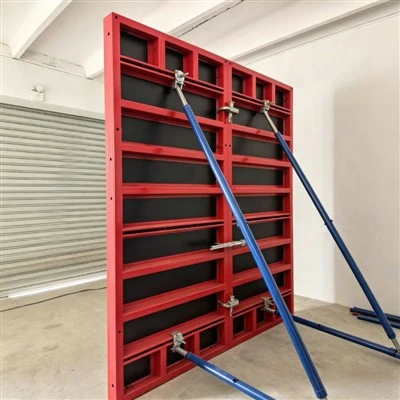
Film faced plywood is a standalone panel, but it works as part of a larger formwork system:
The Panel Itself:
- Plywood core – multiple layers of wood veneer glued together, cross-grained for strength
- Film coating – phenolic resin impregnated paper, bonded to one or both faces
- Edge sealing – waterproof paint or epoxy on cut edges to prevent moisture ingress
Works With:
- Timber beams – H20 or other beams as vertical or horizontal supports
- Steel walers – horizontal reinforcement
- Formwork ties and clamps – panel-to-panel connections
- Adjustable props – vertical support
Optional:
- Pre-drilled holes – for tie rods or fixing points
- Custom sizes – cut to project requirements
- Edge banding – additional protection on cut edges
Competitive Edge
Concrete finish. The phenolic film gives you a smooth, glossy concrete surface. No other plywood product delivers the same finish quality without additional treatment.
Waterproof. The film coating and WBP glue mean the panel handles moisture without delaminating. It can sit in rain, get hosed down, and come back for another pour.
Easy release. Concrete does not stick to the film face. Stripping is quick and clean. You do not need release agent in most cases.
Lightweight. Compared to steel or aluminium, it is much easier to handle. One person can carry and position most panels.
Cost-effective. Lower upfront cost than metal formwork. With 50–100 reuses, the per-use cost is competitive.
Workable. Cut it, drill it, nail it – standard woodworking tools work fine. You can shape it on site without special equipment.
Proven. Film faced plywood has been used in concrete formwork for decades. The technology is mature and well understood.
Services
- Cutting to size – custom panel sizes available on request
- Edge sealing – waterproof edge treatment for cut panels
- Pre-drilling – holes for tie rods or fixing points
- Technical support – video consultation within 24 hours
- Delivery – standard panels in 3–5 working days; custom orders 7–10 working days
- Samples – available for testing; freight to be covered by buyer
FAQ
Q: How many times can film faced plywood be reused?
A: Depends on the grade. High-quality panels with phenolic film and WBP glue achieve 50–100 cycles. Standard panels deliver 8–20 uses. The key factors are film quality, glue type, and how well you look after the panels.
Q: Do I need to use release agent?
A: Usually not. The phenolic film surface is non-stick – concrete releases easily without release agent. For critical finishes or first use, some contractors still apply a light coat, but it is not required.
Q: Can film faced plywood be used in wet conditions?
A: Yes. The film coating and WBP glue make it waterproof. It handles rain, wet concrete, and humid site conditions without delaminating. Cut edges should be sealed with waterproof paint to prevent moisture ingress.
Q: What is the difference between black film and brown film?
A: Black film is typically heavier (220–240g/m²) and more wear-resistant – used for high-reuse formwork. Brown film is lighter (120–165g/m²) – used for standard formwork where fewer reuses are required.
Q: Can film faced plywood be cut on site?
A: Yes. Standard woodworking tools work fine – saws, drills, nail guns. Cut edges should be sealed with waterproof paint or edge sealer to prevent moisture from getting into the core.
Q: What is the difference between film faced plywood and ordinary plywood?
A: The film coating. Ordinary plywood has no surface coating – it absorbs moisture, concrete sticks to it, and the surface is rough. Film faced plywood has a phenolic resin coating that is smooth, waterproof, and non-stick.
Q: What glue type should I choose?
A: For concrete formwork, WBP (weather and boil proof) glue is the best choice. It withstands moisture and repeated use. Melamine glue is a mid-range option. MR glue is for light-duty or indoor use only.
Q: What thickness should I choose?
A: 18mm is the most common thickness for concrete formwork. 15mm works for lighter loads or shorter spans. 21mm or 25mm is used for heavy loads or where you need extra stiffness.
Q: How should film faced plywood be stored?
A: Store flat, off the ground, in a dry place. Cover stacks to protect from rain. Avoid storing in direct sunlight for long periods – UV can degrade the film surface. Seal cut edges immediately after cutting.
Q: Can I get custom sizes?
A: Yes – custom sizes are available on request. Minimum order quantities may apply for non-standard dimensions.
Hot Tags: film faced plywood, China film faced plywood manufacturers, suppliers factory, 3 Ply Yellow Shuttering Panel, Anti Slip Film Faced Plywood, Film Faced Plywood, formwork, PP Film Faced Plywood, wood plywood formwork